
The shear is the most delicate part of the machine: the one subject to the greatest wear and stress, and the one that undoubtedly deserves the most attention in the choice of design solutions, in order to avoid frequent interventions and high maintenance costs over time.
When new, they all — or almost all — appear up to the task awaiting them, but the real judge is time, and with time the problems caused by wrong choices, or choices made without due care, arise and, unfortunately, have to be endured.
For the shear, the number of cutting cylinders and vertical compression cylinders must be analysed.
The adoption of two cutting cylinders, rather than a single cylinder, has made it possible to minimise contact friction.
The cutting system is better balanced, resulting in greater cutting capacity and less wear on the guides, to the benefit of a longer service life.
With twin cylinders, for the same overall dimensions of the shear structure, the guiding ratios of the pistons are also improved, and wear and maintenance interventions are reduced.
Last but not least, it is easier to dismantle two small cylinders than one large cylinder.
The vertical compression that precedes the cut is, like the cutting force, of fundamental importance in producing quality scrap.
The more the scrap is compressed, the greater the payload on the transport vehicles and the load in the steel mill charging basket.
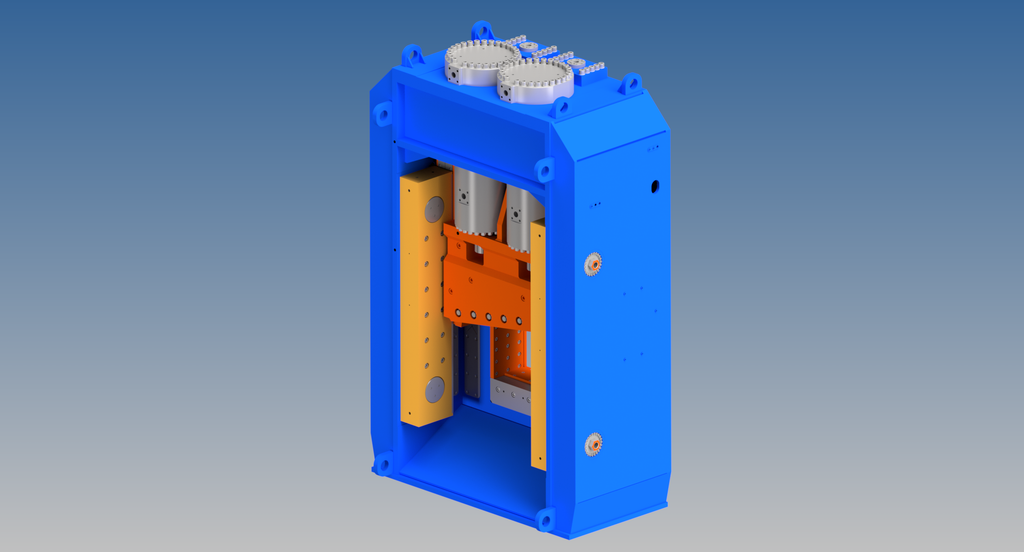
In a shear, what matters is the shape and sizing of the guide surfaces and the “guide ratio”, that is, the ratio between the length of the guides and the cutting width (L/l > 1.5).
A low ratio and insufficient sizing mean high stress concentrations on the guides and on the blade holder, with consequent premature wear and a limited service life of both guides and blades, and overstressing of the blade holder and of the shear structure.
The result of a wrong choice is, over time, frequent maintenance interventions and high operating costs.
Six-sided prismatic guides are recommended: machined with precision, they are the ideal solution for transferring and distributing the cutting forces into the structure and, compared with other solutions, they simplify adjustment operations.
The materials chosen for the fixed and moving guides of the shear, and their lubrication, are also very important: together with other choices, they determine the percentage of force lost to friction.
For the fixed guide–moving guide coupling, synthetic material on high-alloy hardened steel should be preferred: this choice allows the solid particles present in the dust to become embedded in the plastic material, avoiding seizure from sliding.
Synthetic guides are self-lubricating, and a temporary lack of lubricant does not compromise their service life, whereas the other solutions need careful lubrication and suffer wear caused by dust.
With the possibility of using new-generation composite materials, guides with steel-on-steel or bronze-on-steel coupling are now an outdated and obsolete solution.
Adjusting the clearance between the blades and restoring the correct tolerance of the mobile blade holder’s clearances must be possible in safety, with simple operations that can be entrusted even to unskilled labour; a successfully tested solution is the use of gibs adjustable by means of eccentric pins, a technique that facilitates and simplifies maintenance compared with other solutions.
The choice of the inclination angle of the moving blade is of fundamental importance in a scrap shear. Its value must balance greater cutting capacity against the overloads resulting from excessive inclination.
The most reputable manufacturers have opted for cutting angles between 7° and 10°.
Only a few have chosen cutting angles of 12 degrees or more.
With angles close to 12°, during the cut the material is pushed against the wall of the shear in the direction of the blade opening, which means inducing lateral forces that cause eccentric loads on the mobile blade holder, overloading of the structures, increased stress on the shear wall and strong friction between the side guides.
It has been found that with a moving blade inclination greater than 10°, the advantage of a small increase in cutting capacity is offset by a significant increase in wear, even more evident if, in addition to an excessive cutting angle, the guides are insufficiently sized.
Conclusion: with an ill-considered choice, rapid wear of the guides is at stake, and what has been gained in cutting capacity is lost in friction.
Machines with cutting angles of 9 and 10 degrees, depending on the cutting force, are the right compromise between cutting efficiency, guide wear and overloads on the moving blade holder and on the shear structure.
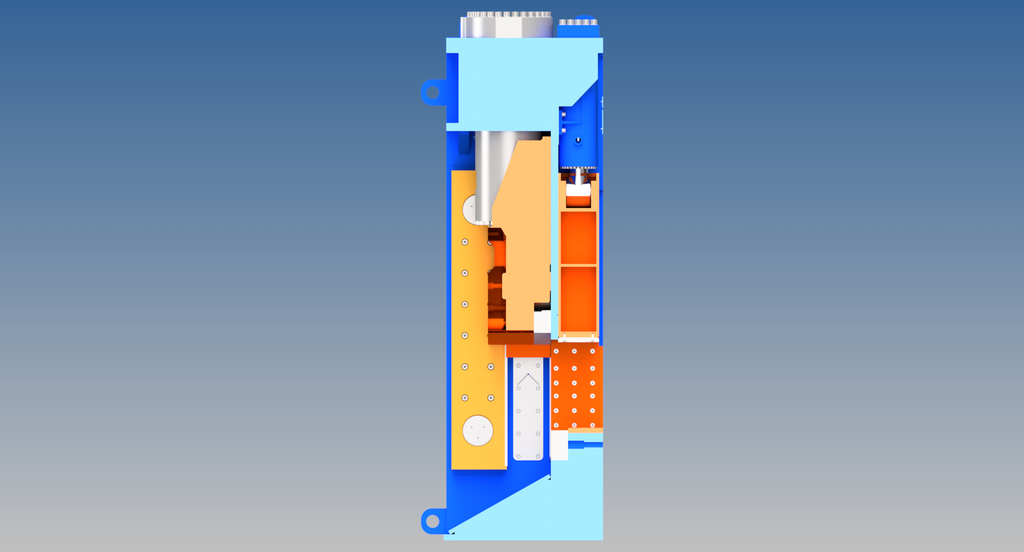
It is also important to analyse how the blades are fastened and protected in their seat.
The blades must be seated in a removable blade holder, which in turn is housed in the structure of the shear and of the mobile blade holder.
The design of the blade support seat and the solidity of the blade holder’s supporting structure must not be underestimated.
Inappropriate construction and the use of poor-quality materials for the blade holder and its seat can, over time, deform the support surface, causing a permanent deformation that prevents the correct clearance between the blades and consequently leads to blade breakage.
A good support surface and a base structure in high-yield-strength steel protect the surface from deformation.
While the mobile blade holder can be removed from its seat if the support surfaces need to be restored, the support surfaces machined into the shear structure are not easily accessible.
For this reason, for the seat machined into the shear structure, it is advisable to provide support surfaces suited to the various cutting forces, incorporating into the structure thick steel plates with a high elastic limit.
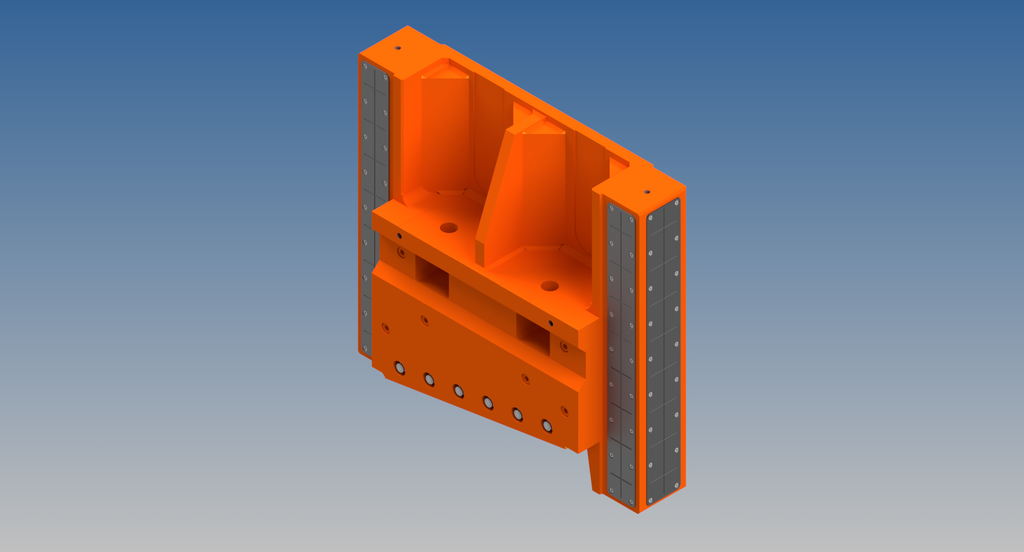
When the fastening screws of the fixed blades can be removed from the front, their seats must have interchangeable bushings.
The drawing shows a solution with guide rings, designed to lock the blades in their seat, which has given good results in practice.
conclusion, to ensure consistent cutting characteristics and a long life for blades and guides, you need appropriate blade holder seats with large support surfaces, tensioned blade screws without radial play, and a moving blade holder with a well-designed structure supporting the blade seat.
Excessive elastic deformation of the moving blade holder during cutting causes blade breakage.
What about wear?
Years ago (many years ago), the head of research and development of a major French company used to say: “I will never let my company buy a ‘disposable’ shear.”
Always be wary of shears with welded guides and/or without interchangeable wear plates on the surfaces in direct contact with the scrap.
They may cost less when you buy them, but when all is said and done you are in trouble!!
As he used to say: “they are like those cheap razors: when they lose their edge, they are for the bin.”
Eng. CLAUDIO COLOMBO