MOBILE SHEAR BALER
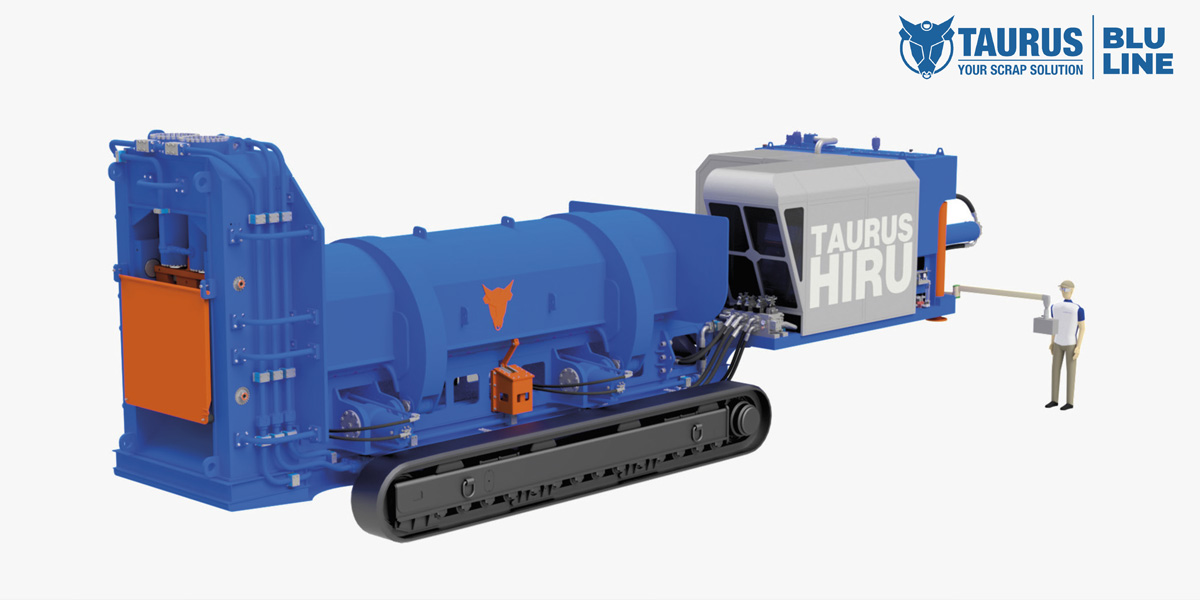
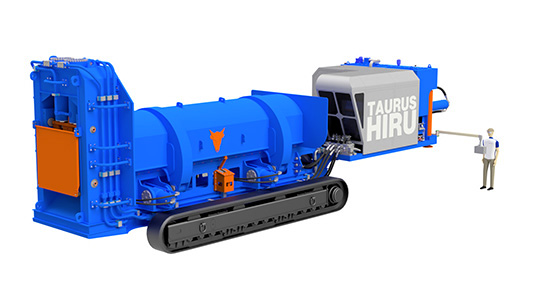
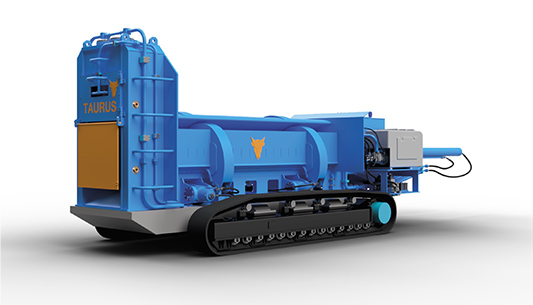
HIRU: THE TRACKED SHEAR BALER
The mobile shear baler represented a significant
development in the scrap recycling sector, subsequently evolving into a self-propelled tracked configuration based on the principle: “if the scrap doesn’t go to the shear, the shear goes to the scrap”.
Track mobility has increased operational flexibility,
allowing the machine to reach the scrap directly and
then shear it on site.
However, this mobility does not permit indiscriminate
movement around the site, nor can shearing be carried out haphazardly or in areas not previously defined and secured.
A tracked shear baler is not merely a mobile vehicle, but a high-energy process machine, characterized by heavy masses, large dynamic dimensions and extremely high compression and cutting forces.
Under these conditions, safety cannot depend solely
on the operator’s attention or on ‘real-time’ risk
management.
The Machinery Directive 2006/42/EC requires that risk be eliminated or reduced at source through the design of the machine.
When the interaction between the operator and the machine is constantly changing, the machine’s path becomes less predictable, hazard zones are harder to identify, and the risk tends to shift to the operator and the site management, particularly if the machine stops to cut at random points along the route that have not been designated and secured in advance. In such cases, one of
the key principles of machine safety is compromised: the prior definition of the work area and the hazard zone..
HIRU: ENGINEERED FOR SAFETY
HIRU was developed to overcome this design
limitation by introducing a new philosophy: transforming
safety from an operational procedure into a structural
feature of the machine.
For this reason, HIRU introduces and integrates the two technologies ARD and DAS (“Italian Patented Pending”).
ARD physically and precisely defines the operating
position, making the trajectory clear, the turning
radius perceptible and the maneuvering areas clearly
identifiable.
Safety no longer depends on the operator’s variable
position, but on a stable geometry designed in advance.
DAS – “Drive Assistance Sensor” – completes the safety
architecture by monitoring people, obstacles and
interference within the operating area.
The system dynamically controls the path, automatically reduces speed and stops the machine in the event of hazardous situations. During operation, DAS defines, delimits and monitors the danger zone around the shear baler, detecting any intrusions or unauthorized presence.
The integration of ARD and DAS thus transforms the tracked shear baler into a system in which safety is not primarily reliant on human behavior but is incorporated into the design logic of the machine itself.
HIRU therefore introduces a new paradigm in the selfpropelled shear baler sector: eliminating operational uncertainty and making safety a structural, predictable, repeatable and designed feature..
FEATURES
Equipped with the original TAURUS swing-wing compression system, featuring an additional 16° stroke on both lids.
TRACKS 4WD
- “4WD (Italian Patent Pending): a dual‑drive undercarriage equipped with four independently driven crawler tracks to maximise traction and ensure reliable operation even on highly irregular ground conditions.
STRUCTURE
- Box and wings featuring a sandwich structure with reticulated core, designed to increase bending and torsional stiffness
- The surfaces in direct contact with the scrap, as well as the inner and outer surfaces of the lids, are made of wear‑resistant steel
- Chassis
ELECTRONICS SYSTEM
- CSA: end‑of‑stroke decelerators
- EPS: non‑contact stroke limiters
- ECA: stroke economizer
- KNEE (Patented): Angular sensor for monitoring
the lids’ over‑stroke - IDS: inductive end‑of‑stroke sensors
- HP: work‑cycle economizer
- BOOSTER
- Remote diagnostics and remote technical assistance
- Double‑enclosure electrical cabinet
- Touch screen
HYDRAULIC UNIT
- Axial piston pumps with working pressures up to 420 bar
- Oil filtration and cooling pump
- Piloting pump
- Steel distribution panels
- CETOP‑standard valves
- Proportional valves
- SIR: integrated fast/slow cycle system
- Logic‑element panel
- BOOSTER
- Air filters
- Oil filtration performed on an independent external circuit
- Pilot line filter
- Air‑oil cooling
- LCC: centralized shear lubrication system
SAFETY
- ARD (Italian Patent Pending)
- DAS (Italian Patent Pending)
ON DEMAND
- Self‑supporting loading hopper without external auxiliary support structures
- LM: air‑conditioned operator cabin
- TER: pre‑compression monitoring system
- LAC: automatic hinge lubrication
- LAS: automatic lubrication of the cylinder‑lid joint
- Oil heating system
TECHNICAL SPECIFICATIONS
| Cutting force | up to T 1000 |
| Clamp | up to T 110 |
| Main compression cylinder | up to T 180 |
| Box length | up to mm 7200 |
| Motorization | Diesel |