
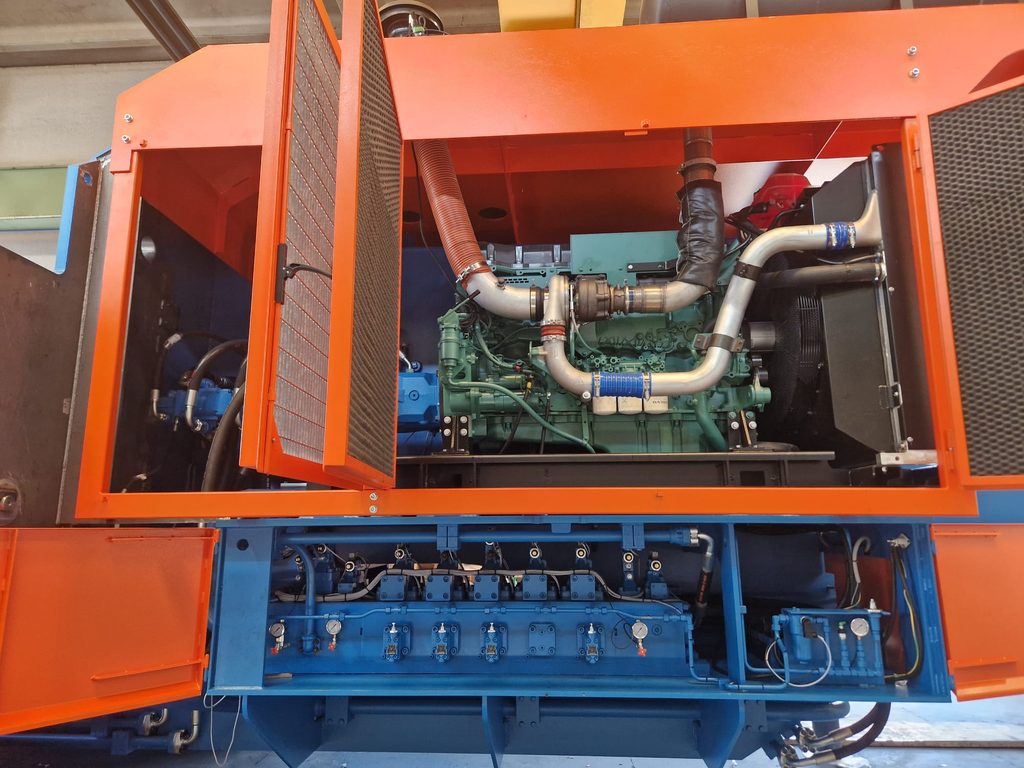
Every manufacturer has its own view, but the use of constant-power piston pumps is beyond dispute, with the obvious exception of the service pumps.
Always and only piston pumps!!!
Beware of combinations of piston pumps and low-pressure pumps.
Especially when the ratio between the flow rate of the piston pumps and the total flow rate is low.
The low-pressure pumps are used for the rapid approach, after which only the piston pumps work, with a drastic drop in working speed, all the more noticeable the lower the ratio between the piston pump flow rate and the total flow rate.
Idling, the machine seems fast, but under load it becomes slow.
You will end up with a machine that does not produce what it promises at first sight.
Low-pressure pumps only serve to reduce the cost of the hydraulic system for the same oil flow rate.
For the hydraulic system, the use of hydraulic piston pumps fitted with a constant-power control device is recommended.
With this particular type of drive, one can exploit, among other things, the possibility of reducing speed with a simultaneous proportional increase in force.
For the same production, this makes it possible to limit installed power, with a consequent reduction in energy consumption per unit of sheared product, and to modulate the power factors involved according to the different shearing conditions.
It is true that energy consumption must be considered, but it is also true that if you want to run, you need a powerful engine under you.
In addition, particular attention must be paid to the filtration systems: air filters on the tank, pressure filtration on the pilot circuit, filtration on the return line and an independent filtration circuit.
Some will object that they are too many; I say that you can never have enough filters, because it is better to change a filter than a pump.
The hydraulic power unit must be “clean”, that is, tidy and accessible.
Few pipes, with flexible hoses only where necessary.
The set of valves making up the system must be mounted on distribution panels and must represent a suitable compromise between traditional spool elements and 2-way logic elements, for the sake of a sound functional balance and easy maintenance, even by non-specialist technicians.
The preface of the book “Tecnica ed impiego delle valvole a cartuccia” (Technology and use of cartridge valves), published by REXROTH (for the few who do not know, an important manufacturer of cartridge valves), reads: “The technique of 2-way cartridge valves (logic elements), euphorically promoted years ago as a substitute for all traditional control components, has now become solidly established as a complement to spool valve technology.”
Only a few years ago, 240 bar was considered extreme. Today, 350 bar is standard, at TAURUS, we operate at 420 bar..
The components are ready: the pumps have been for some time, and recently the valves have caught up too.
As pressure increases, volumes decrease, everything becomes more compact and the quantity of circulating oil is reduced… and why not, so are construction and maintenance costs.
Eng. CLAUDIO COLOMBO