Buying a shear for the volume reduction of scrap is, today, a difficult choice that requires careful research and evaluation of the machine’s design features in the jungle of offers available on the market.
To describe the purchasing options we could have used the word “numerous”, but “jungle” is more appropriate, because among the suppliers there lurks a multitude of improvisers and pseudo-designers.
A shear is a major investment that must provide a service life of at least 20,000 hours of honest work, and possibly in good health: in continuous operation, with no increase in maintenance costs and no loss of productivity compared with the first months of work.
Today more than ever, a shear is a choice that, as the result of an ill-considered decision, can over time become a cost far higher than its depreciation.
In a world as rational as ours, it is irrational to get wrong the decision about what, for most scrap yards, is the pivot around which production turns.
A pivot of which you normally have only one, and if it stops, you are in trouble!
I do not claim that these few notes are a complete and exhaustive list of selection criteria, but they try to give general guidance on the fundamentals that a shear intended for scrap processing must have today.
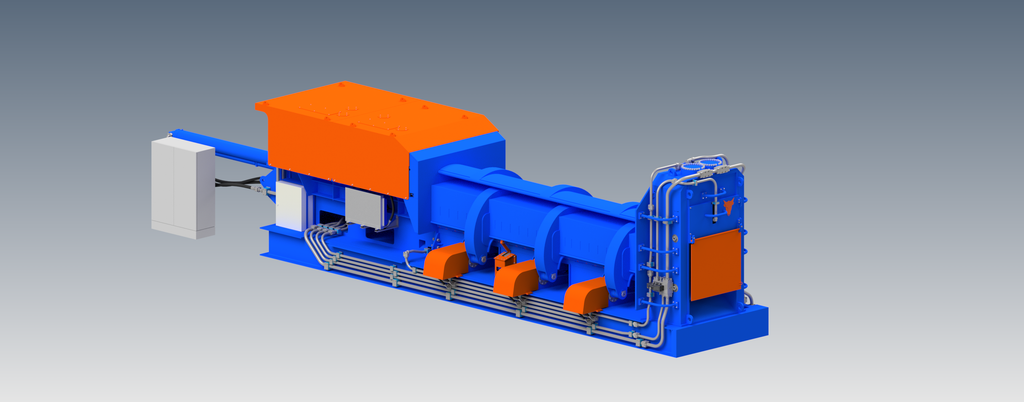
Hydraulic shears for scrap processing first appeared in the early 1950s, with few manufacturers and modest ambitions. Side-compression boxes 5 metres long, with average cutting widths of 600 mm and cutting forces of around 500÷600 tons.
In those years, the compression and automatic shearing of “old iron” were carried out with hydraulically driven “baler&shears” that were bulky, heavy, difficult to load and operate, expensive and intended for only a few users.
In the 1970s, in the USA, a manufacturer (Mosley) introduced a shear with 250 tons of cutting force, a 6-metre box, swinging “orthogonal wing” lids and an 800 mm cutting width: light, compact, easy to handle, loadable from both sides, with little installed horsepower, simple, but above all with purchase and running costs affordable for a wider market.
A new idea that wrong-footed the market for the machines built until then: the new era of “baler&shears” began.
Since then everything has changed, and machines have evolved to meet the economic and operational needs of the “scrap workers”.
The dimensions and pre-compression systems of the boxes have adapted to the cutting forces and to the type of scrap to be sheared.
This radical change in design trends was also made possible by the introduction of new and more advanced technologies and by the availability of modern materials with high mechanical properties.
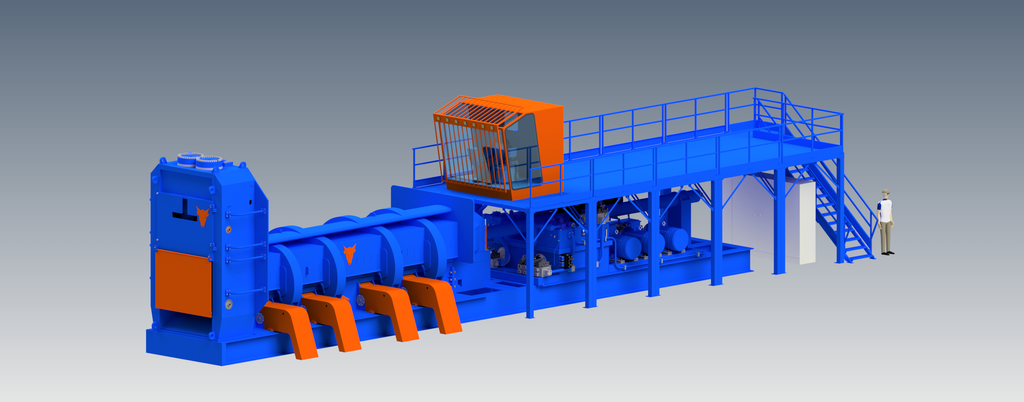
When choosing a shear, it is essential to pay attention to operating costs, and first of all to installation costs.
Hence monolithic machines, preferably on a self-supporting frame, that do not require special permits or foundations.
Machines that are quick and easy to position, operate and reposition.
Today scrap must meet precise supply conditions that guarantee the requirements set by the legislator and by the customer.
Requirements relating to emissions into the atmosphere during melting, to smaller quantities of slag, and to lower production costs through the use of “clean”, furnace-ready materials.
For this reason, collected scrap, light scrap and end-of-life vehicles have taken, or are taking, different routes compared with the recent past, and the shear is left with less scrap to process and the heavier task of shearing difficult and tough, bulky and structural materials.
Hence more effective and flexible shears, able to adapt to the widest range of scrap types.
Cutting forces that increase significantly, and box dimensions whose capacity is aligned with the new requirements.
Only a few years ago, shears with 300 tons of cutting force, 600 mm blades and 5-metre boxes were all the rage, also suitable for producing bales.
Today a 500 tons shear is already considered small, the blade is never shorter than 800 mm, increasing with the cutting force, and boxes are never less than 6/7 metres long, with an opening greater than 2.4 m (the dimensions 2.4x6/7 m correspond to those of the bed of a truck delivering incoming scrap).
The quality of the sheared product is taking precedence over quantity.
Since the shear has to withstand heavier stresses than before, its selection always depends on the fundamental parameters, based on common and essential guidelines.
A shear should therefore be chosen according to its solidity, efficiency and flexibility.
The way to evaluate it is to divide the machine into its fundamental components: design and construction, the shear, the pre-compression box, and the hydraulic and control system.
The first element that distinguishes one shear from another is the MANUFACTURER.
Does it have the size, the machine tools and the structure to build a shear?
True shear manufacturers are few: it is better to take a look at the supplier to see for yourself who designed the machine and where and how production is organised.
In practice, go and see where your money is going.
ING. CLAUDIO COLOMBO