1. General Considerations
From the analysis of the forces, moments, contact pressures, and deformations acting on the guillotine assembly of a scrap shear, as presented in the various previously published studies, an important conclusion emerges:
The selection of guide materials should not be based solely on compressive strength or wear resistance, but above all on the ability of the sliding pair to distribute contact pressures, maintain blade holder accuracy, and operate reliably in the presence of contaminants.
It is reasonable to endorse the approach of using fixed guides made of ground steel and movable guides made of anti-friction material. However, I would add one clarification: this is not an inherently mandatory solution. Rather, it is a particularly rational and effective design configuration for a scrap-processing shear baler.
The fixed steel surface must be sufficiently rigid, wear-resistant, straight, and capable of being replaced or refurbished.
The mobile guide mounted on the guillotine must instead provide smooth sliding, withstand local contact pressures, and, where possible, offer a degree of adaptability to misalignment.
Pressure acting on the mobile guides may be rectangular, trapezoidal, or triangular in distribution, often involving only partial contact. Therefore, a material cannot be evaluated solely on the basis of average pressure.
This aspect is decisive when comparing composite materials, thermoplastics, and bronze.
2. Mechanical Behavior of Different Materials
The main difference among these materials lies in their stiffness perpendicular to the sliding surface.
Under the same pressure, thickness, and boundary conditions, a less rigid material undergoes greater compression. This may allow the guide to accommodate slight rotations of the blade holder, distributing the load over a larger contact area.
This does not mean that the more deformable material is automatically the better choice: if the deformation becomes excessive, the effective clearance between the blades increases, resulting in poorer alignment accuracy.
Material selection therefore consists of finding the best compromise between stiffness, adaptability, dimensional stability, and wear resistance.
3. Comparison of Guide Material Pairings
The following evaluations concern heavily loaded flat guides operating with reciprocating motion in an environment contaminated by dust and metallic particles. These assessments are based on design considerations supported by comparative testing carried out on actual machines.
a. Ground Steel / UP-TF-PTFE
This thermoset polymer composite material, based on an unsaturated polyester (UP) matrix, reinforced with medium-weave synthetic fabric (TF), and modified with PTFE solid lubricants, offers good load-carrying capacity, relatively low friction, and sufficient compliance to reduce pressure concentrations. The compressive modulus is approximately 2,800 MPa, with a typical dry friction coefficient of 0.15-0.20.
Lubrication: The material can operate under marginal lubrication conditions, although light and controlled lubrication is preferable. The accumulation of contaminated grease should be avoided.
b. Ground Steel / PA6 Nylon
PA6 Nylon provides good sliding properties, a relatively low coefficient of friction, and good adaptability to mating surfaces.
PA6 can compensate for minor misalignments and promote a more uniform pressure distribution, reducing local load concentrations. However, as a viscoelastic material, it may exhibit delayed and permanent deformation under high and repetitive loads. Particular attention must also be paid to moisture absorption.
For these reasons, I do not consider unreinforced PA6 a suitable alternative for this application.
Lubrication: PA6 possesses self-lubricating characteristics and can operate with limited lubrication, provided that pressure, speed, and temperature remain within the material's operating limits. Controlled lubrication can improve sliding performance and reduce wear, while avoiding the accumulation of abrasive contaminants.
c. Ground Steel / Glass-Fiber-Reinforced PA6
Glass-fiber reinforcement generally increases stiffness and dimensional stability under load compared with unreinforced PA6. It may improve wear resistance, although not in all cases. Performance depends on fiber content, fiber orientation, counterface characteristics, and the presence of abrasive contaminants.
Exposed fibers can also contribute to wear of the steel mating surface.
Lubrication: Lubrication is recommended to reduce friction and operating temperature, provided it does not trap abrasive particles. The specific PA6-GF formulation should be carefully evaluated.
d. Ground Steel / Ertalon
Ertalon 6 SA is essentially a cast, unreinforced PA6 material. It is more compliant and more sensitive to temperature, moisture, and long-term deformation than reinforced alternatives. It may initially adapt well to the mating surface, but this capability does not guarantee long-term maintenance of the required blade clearance.
Lubrification: generally beneficial; however, I would not select this material as the first option for the most heavily loaded guideways.
e. Ground Steel / Bronze
Bronze exhibits significantly greater stiffness than polymer composites. It retains its geometry under load more effectively but provides very little compensation for blade-carrier rotations. In the presence of initially triangular contact conditions, it may therefore generate high pressure concentrations at the edges.
Lubrification: with conventional bronze, I would recommend a reliable grease or oil lubrication system, ensuring proper distribution and protection of the contact surfaces. Self-lubricating bronze grades incorporating solid lubricant inserts are also available, but they represent a different category of materials and should be evaluated separately.
For the guideways of a shear baler blade carrier, the bronze alloys I would consider are:
EN Designation
Standard Grade
Features
CuSn12-C
CC483K
Tin bronze with good wear resistance and excellent sliding properties.
CuSn7Zn4Pb7-C
CC493K
Leaded bronze with good anti-friction characteristics.
CuAl10Fe5Ni5-C
CC333G
Aluminium bronze with high mechanical strength and excellent wear resistance.
For the intended application, with mating guide rails made of ground steel having a hardness of approximately 450 HB, I would primarily consider the following: CuSn12-C (CC483K) as a conventional bronze for sliding guideways, provided that adequate lubrication is ensured.
4. How Much Does Surface Conformability Change?
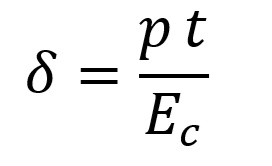
The difference can be quantified using the following relationship:
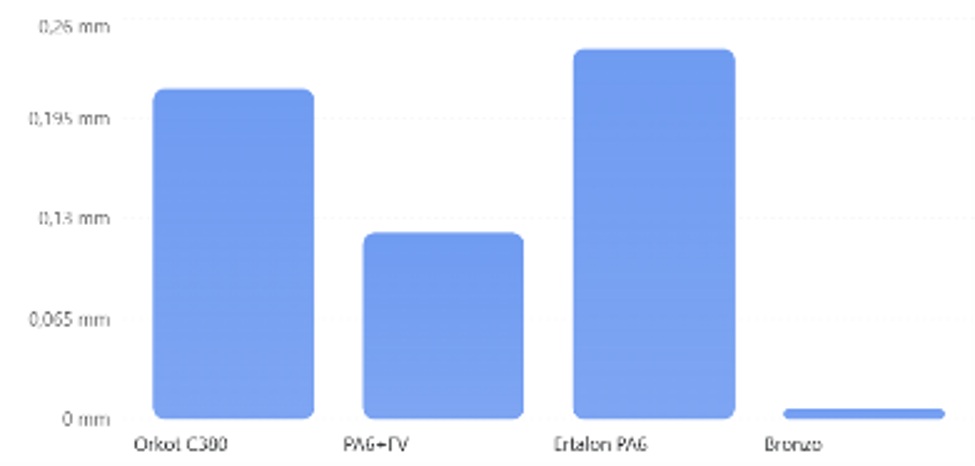
Approximate Elastic Compression at 40 MPa
Assumendo, come esempio, uno spessore di 15 mm e una pressione locale di 40 MPa,
5. Lubrication: The Most Important Difference
Pairing
Performance with Poor Lubrication
Recommended Lubrication
Steel / UP
Relatively favorable
Light, compatible lubrication with regular cleaning
Steel / PA6 + Glass
Possible, depending on the formulation
Controlled lubrication, preferably with protection against contaminants
Steel / Ertalon PA6
More sensitive to heating and prolonged loading
Regular lubrication, compatible with PA6
Steel / BR14 Bronze
More critical without lubrication
Centralized lubrication system with proper distribution and sealing
In scrap shears, the challenge is not simply to provide lubrication; it is to prevent the lubricant from retaining dust, oxides, and metallic particles, which can form an abrasive paste.
For this reason, wherever possible, priority should be given to scrapers, guards, and dirt-ejection systems rather than simply increasing the grease quantity.
The steel surface finish is also critical. As an initial reference, a surface roughness (Ra) in the range of 0.2-0.4 µm should be considered, subject to confirmation for the specific material pairing selected, as there is no universally optimal roughness value.
6. Which Material Adapts Best to Surface Irregularities?
Three distinct phenomena must be considered separately.
Elastic Conformability:the sliding pad compresses locally where pressure is highest and recovers, at least partially, when the load decreases. This is the desirable behavior for achieving a more uniform pressure distribution.
Permanent Settlement:the material deforms and does not fully recover. While this may initially increase the contact area, it also alters the guide clearance.
Wear:material is removed from the surface. This can also appear to increase the contact area, but at the cost of reduced accuracy and service life.
For the guillotine assembly of a scrap shear, these three phenomena should not be confused.
Material
Elastic Conformability:
Risk of Permanent Deformation
Sensitivity to Localized Contact
UP-TF-PTFE
Good
To be verified under cyclic loading
Relatively favorable
PA6 + Glass Fiber
Moderate, depending on fiber content and orientation
Depends on formulation and operating temperature
Moderate
Ertalon PA6
High
More critical in the long term
Favorable initially, but less stable over time
BR14
Very limited
Generally low within allowable loads
High if parallelism is not maintained
The ideal material is not the one that compresses the most, but the one that distributes pressure effectively without causing an excessive increase in permanent clearance.
7. Alternative Materials Worth Considering
In addition to the four materials discussed above, I would evaluate three further material families.
Low-friction structural composites based on fabric reinforcement and resin matrices, incorporating PTFE or graphite..
Self-lubricating composites with a metallic backing.These materials can provide greater overall stiffness combined with a low-friction surface layer. They are particularly attractive where guide clearance must remain highly stable. However, the effective thickness of the anti-friction layer and the local contact pressures at edges and corners should be carefully verified.
Self-lubricating graphite-plugged bronze alloys.I would consider these materials where a stiffer guide system is desired, combined with a very accurate alignment system and effective protection against contaminants.
8. Fixed Guide Rails: The Preferred Solution for Scrap Shears
Heat-treated steel, with appropriate surface hardness, final grinding, and replaceable wear surfaces. Surface hardening should be considered wherever contact pressures and abrasive wear justify it, while avoiding excessively high hardness at the expense of toughness.
A hardness of 450 HB corresponds approximately to 47-48 HRC, depending on the steel grade and the applicable conversion tables.
For fixed guide rails, this hardness level offers several advantages:
- Wear resistance: good resistance against sliding contact with polymer guide pads.
- Scratch and scoring resistance: superior to that of conventional non-hardened structural steel.
- Resistance to surface deformation: suitable for many applications involving high contact pressures.
- Final machinability: ground surfaces with good geometric accuracy can be achieved through an appropriate manufacturing process.
However, it remains essential to verify both the steel's toughness and the depth of the hardened layer.
Comparison with Moving Guide Pad Materials
Pairing
Assessment of 450 HB Hardness
450 HB Steel / UP.TF.PTFE
Very favorable
450 HB Steel / Nylon PA6
Very favorable
450 HB Steel / PA6 + Glass Fiber
Favorable, with attention to fiber-induced abrasion
Steel 450 HB / Bronze BR14
Favorable, provided adequate lubrication is ensured
In the case of bronze, a higher hardness of the mating guide rail does not compensate for deficiencies in lubrication or alignment.
Comparison with Contact Pressures
The local contact pressures are estimated to range between:
- 27-29 MPa under trapezoidal contact conditions at maximum combined loading;
- 40-50 MPa under initial conditions with localized contact.
These values are significantly lower than the equivalent hardness level of the steel.
However, it is not correct to directly compare Brinell hardness with contact pressure to demonstrate the safety of the guide system. Hardness does not replace the necessary verification of strength, fatigue resistance, stiffness, and wear performance
For a steel guide rail with a hardness of 450 HB, the primary concerns may therefore not be surface crushing, but rather:
- Abrasive wear caused by hard metallic particles.
- Elastic deformation of the guide rail and its supporting structure.
- Load concentrations at edges and corners.
- Fatigue resistance of fasteners and contact surfaces.
The Solution to Be Adopted
Feature
Preliminary Specification
Fixed guide rail material
42CrMo4 steel with appropriate heat treatment
Hardness
420-480 HB, target value 450 HB
Surface finish
Ground
Initial surface roughness to be evaluated.
Ra 0,2–0,4 µm
Sliding shoe preferred
UP.TF.PTFE
Shoe thickness
15 mm
Protection
Scrapers and protection against contaminants
Lubrification
Moderate and controlled
Assembly
Machined seating and screw fastening
Positioning
Seated against the mounting surface, with mechanical locating features to prevent sliding
Conclusion
For fixed guide rails paired with UP-TF-PTFE, a hardness of 450 HB represents a reasonable target.
There is generally no need to increase hardness beyond this level without a specific justification, since, for this particular application, straightness, structural rigidity, surface finish, and protection against abrasive contaminants are equally important factors.
The Most Interesting Aspect: The Guide Shoe Installed in a Machined Seat
Machined recesses incorporated into the structure, or dedicated locating features, must prevent relative movement of the guide elements. The fastening screws should not be the only components responsible for preventing displacement of the plates under tangential forces.
The fact that both the guide and the counter guide are accommodated within properly designed seats provides good geometric restraint of the guide shoe.
This arrangement can offer three advantages:
- Reduced risk of lateral movement of the guide shoe.
- Improved support against transverse deformation.
- Greater geometric stability of the system compared with a surface-mounted shoe.
However, an important distinction must be made.
If the pressure acts on the exposed surface and the reaction force is transmitted through the base of the seat, the compressive load path extends through the entire thickness of the guide shoe.
The preliminary relationship therefore remains:
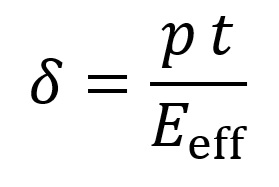
with t = guide pad thickness
Lateral confinement within the seat may modify the effective modulus relative to that of an unconstrained plate
Influence on Pressure Distribution
Confinement within the seat may increase the apparent stiffness of the material, reducing compressive deformation.
This produces two opposing effects
- Advantage: reduced blade-carriage deformation and improved maintenance of blade clearance.
- Disadvantage: reduced ability of the pad to accommodate blade holder rotation, with a possible increase in localized contact pressures.
Therefore, an increase in stiffness should not automatically be regarded as beneficial.
Influence on Contaminant Embedability
A configuration in which the anti-friction material slightly protrudes from the seat is also interesting from a tribological standpoint.
The exposed anti-friction surface remains in direct contact with the steel and can retain its ability to absorb or embed small foreign particles
The metallic seat, meanwhile, supports the guide pad and limits its displacement.
For this reason, the configuration is particularly well suited to UP-TF-PTFE.
With PA6 Nylon, greater attention must be paid to thermal expansion and moisture absorption, since an excessively restrictive seat may generate additional stresses, surface distortion, or loss of flatness.
One Aspect That Requires Careful Verification
For guideway sizing purposes, the amount of pad protrusion should not be confused with the thickness that is actually available for elastic deformation.
The total deformation of the guide pad, together with blade-carriage rotations, determines the actual blade position under load.
The presence of machined seats is advantageous, but it does not eliminate the need to verify the stiffness of both the guide plates and the supporting structure.
Recommended Design Configuration
Fixed guide rails:: mounted plates of 42CrMo4 steel, approximately 450 HB hardness, ground and secured within machined seats.
Moving guides: UP-TF-PTFE,installed within a machined seat with sufficient protrusion beyond the supporting surface.
Adjustment system: a mechanism allowing guide clearance to be maintained and corrected without direct intervention on the guide pads themselves.
Protection: scrapers and devices designed to prevent metallic debris from entering the sliding surfaces.
For this application, this configuration is considered preferable to a steel-bronze pairing, primarily because of the composite material's ability to accommodate minor misalignments and its potentially more favorable behavior in contaminated operating conditions.
9. Contaminant Embedability in Guide Systems
During operation of the guillotine assembly, oxide particles, mill scale, metallic dust, and small scrap fragments may penetrate between the moving guide and the fixed guide rail.
When a hard particle becomes trapped between two relatively rigid surfaces, it can cause scoring, abrasive wear, and localized pressure increases.
A sufficiently compliant anti-friction material, on the other hand, can allow the particle to become partially embedded within its surface, reducing the particle's protrusion and therefore its abrasive action against the steel guide rail.
This property is generally referred to as embedability, namely the ability of a material to absorb and retain foreign particles within its surface.
Comparison of Materials
Material
Indicative Embedability Capacity
Behavior in the Presence of Abrasive Particles
UP-TF-PTFE
Good
The polymer matrix can accommodate small particles; however, exposed fibers and hard particles may still cause abrasive wear.
PA6 + Glass Fiber
Intermediate and dependent on the formulation
The matrix may deform, but the glass fibers locally reduce embedability and may contribute to abrasive wear.
Ertalon PA6
Potentially high
The higher deformability can improve embedability, but may also promote permanent deformation and the retention of abrasive particles.
Bronze BR14
Generally more limited, depending on hardness and microstructure
Foreign particles may score the mating guide rail or become partially embedded in the bronze, while remaining abrasive.
The phenomenon that must be avoided
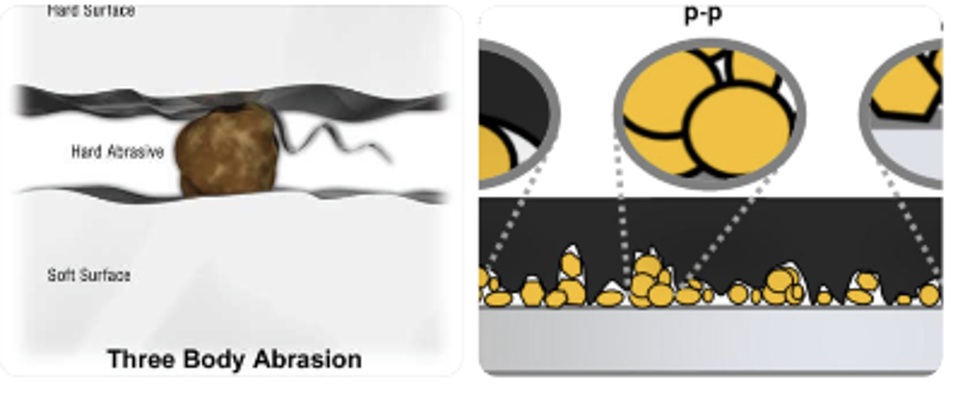
Rigid coupling: A trapped particle may score one or both surfaces, causing scratching and abrasive wear.
Coupling with a deformable material: A sufficiently small particle can become embedded in the bearing surface, reducing abrasive contact with the steel.
Behavior of Mating Surfaces in the Presence of Solid Contaminants
An additional criterion for selecting materials for blade-holder guides is their ability to embed foreign particles (embedability).
In scrap processing shear balers, sliding surfaces are exposed to the potential ingress of metallic dust, oxides, mill scale, and small solid particles.
Compared with steel-bronze pairings, some polymer-based bearing materials can offer a greater ability to locally embed small particles, minimizing their protrusion and reducing the risk of scoring the steel counter-guide.
This behavior depends on the material’s surface deformability, internal structure, the presence of fiber reinforcement, the size and hardness of the particles, as well as the contact pressure.
UP-TF-PTFE, thanks to its polymer matrix and inherent deformability, can offer favorable particle-embedding behavior. In contrast, in glass-fiber-reinforced PA6 materials, the presence of reinforcing fibers may locally limit this capability. Unreinforced PA6 may be more deformable, but it presents greater challenges in terms of dimensional stability under load.
Bronze can also embed foreign particles, particularly in the most suitable alloys and surface conditions; however, in a rigid, heavily loaded pairing, hard particles that are not fully embedded may cause scoring and abrasive wear.
The particle-embedding capability should therefore not be regarded as an absolute form of protection: particles that remain trapped yet still protrude from the surface may increase abrasion of the steel counter-guide.
For this reason, the selection of the bearing material should be complemented by effective protection of the sliding surfaces, the use of scrapers, and a lubrication system that does not promote the accumulation of contaminants.
by Eng. Colombo (original version in Italian)