
INCLINED SHEAR CONTINUOUS FEEDING
BLACKLINE
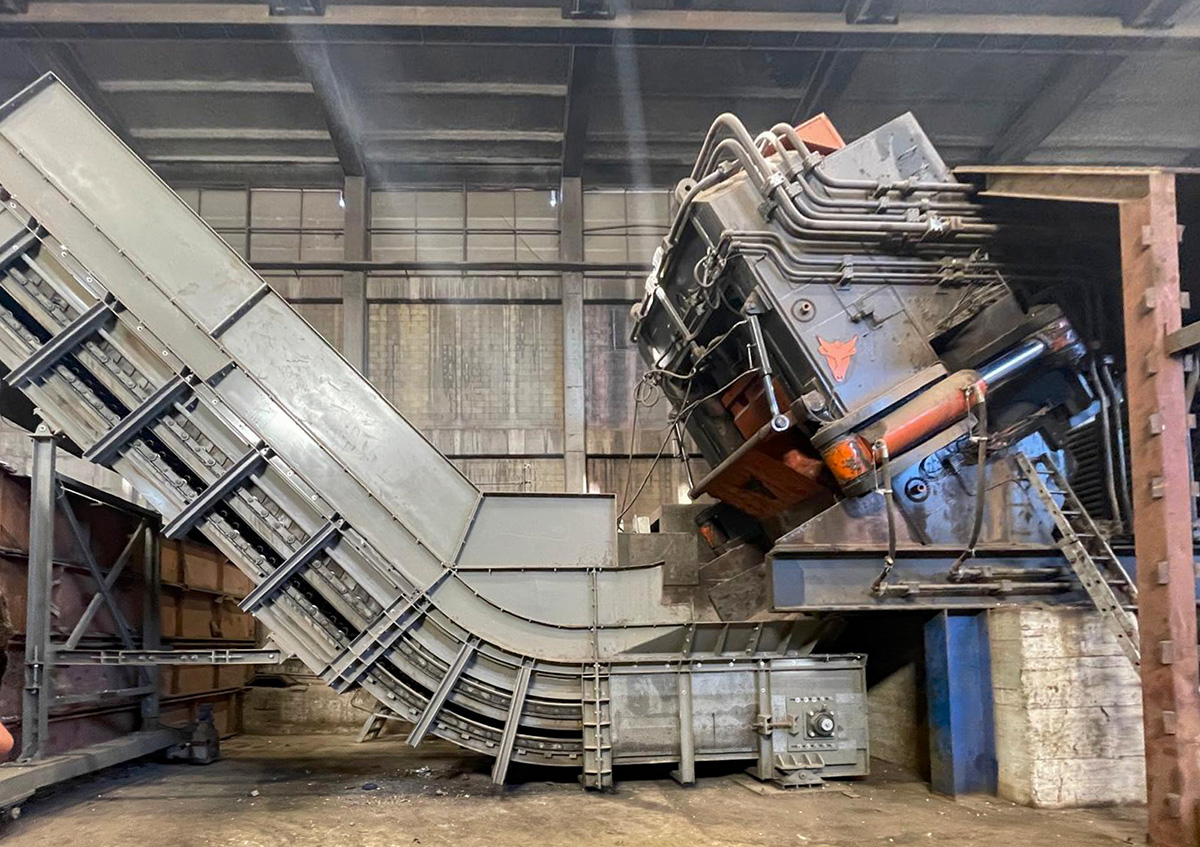
The BLACKLINE line of continuous feeding shears, which includes the TR, has been subject to improvements and updates. The range has been expanded with the introduction of TR-VHD (very heavy duty) shears with cutting forces up to 1800 t, suitable for continuous shearing of all types of scrap, from profiles, pipes, and pantograph sheets to mixed and bulky scrap, demolition, rails, and rebar.
INCLINED SHEARS
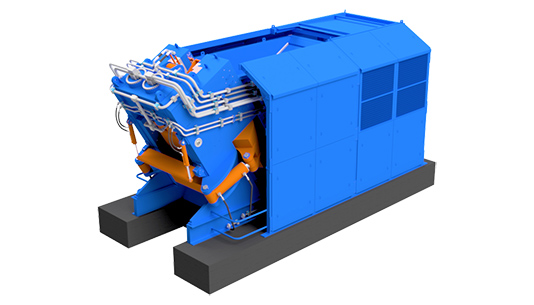
TR INCLINED SHEAR FUNCTIONING

Scrap shears with inclined continuous feeding
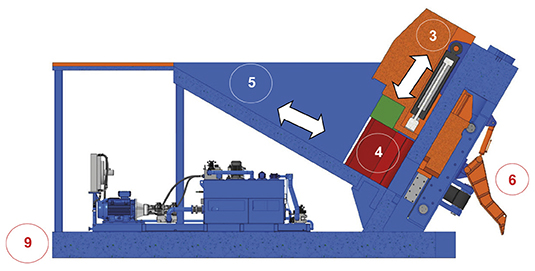
system TR are equipped with a vertical clamp (3) and
two oscillating side lids (4).
The scrap to be sheared is loaded into the feeding
box, which is attached at the front of the shear
structure and consists of a hopper closed at the sides, with an open top and an inclined, oscillating table (1) (5).
After the side “lids” (4) and the vertical clamp (3) have reduced the size of the scrap, the gravity and the push of the inclined /oscillating table (5) let it slide under the shear blades.
The cutting length is defined by the external positive
stop (6). Designed in this way, the machine precompresses and cuts the scrap in a continuous
manner, without the need for manual material
reduction prior to the shearing phase.
The operator’s work is therefore limited to loading
the feeding box.
TR’ shears have a small footprint, concentrate their
weight on the elements subject to stress and wear.
They can also be loaded from both sides and are
operated by a single operator.
CONSIDERAZIONI GENERALI
SULLA CESOIA INCLINATA TR
The reasons for preferring, for scrap shearing, the open‑box continuous‑feed system over the classic and traditional systems that require a manual pre‑compression phase before the automatic shearing cycle are:
- The possibility of shearing long materials, including those longer than the feed‑box dimensions
- “The lower ordinary maintenance costs resulting from reduced wear and from the smaller number of cylinders
- The use of a single operator responsible simultaneously for loading and monitoring the shearing machine’s operation
- Reduced space requirements, thanks to the shear’s compact design and limited overall dimensions
- The absence of production downtime related to preparing the scrap to be sheared. Unlike continuous‑feed slide shears, traditional shears require considering the time needed for the return stroke of the feed cylinder and for the opening of the lids at the end of each cycle.
On the other hand, slide‑type continuous‑feed shears exhibit certain challenges and shortcomings, such as:
- The inability to produce scrap bales
- The lower density of the sheared material results from the vertical compression force being distributed over three stages. Density is generated by vertical compression, not lateral compression, which merely reduces scrap size to a preset position. In slide shears, vertical compression is spread across multiple stages, whereas in traditional shears it is concentrated on a much smaller press surface
- To achieve a sheared‑material density equal to that of traditional shears, gravity‑feed shears require a vertical press force at least three times higher than that of conventional press‑shears
- The cutting length, whose maximum dimension is defined by the external positive stop, is not fixed or constant because it depends on gravity and on the movement of the inclined plane (when present), which serves more to let the scrap ‘slide’ toward the shear than to actually ‘push’ it.
- The depth of the vertical press’s compression stages, which limits the maximum cutting length and prevents bulky material from sliding freely
- The particular attention that the operator must pay when loading scrap into the feed box. The scrap must be loaded and distributed in such a way as to prevent it from ‘floating’ inside the feed box without sliding, and in quantities and sizes that do not compromise the cutting process through overload
- The refusal of the cut due to excessive scrap at the guillotine, since no longitudinal pusher is provided, causes a temporary machine stop in order to free the blades from the material that generated the overload—an issue that occurs more frequently in machines with limited cutting force
- The limitation of being unable to shear certain categories of scrap, due to the opening of the flippers and the vertical press, and to the system’s limited flexibility in adapting to specific types of material
- The loading height, which makes it difficult for the operator to properly see inside the feed box, hindering correct scrap distribution in the loading area and the monitoring of the working phases, unless an appropriate loader is available
- The difficulty of maintenance operations on the inclined parts of the structure, which forces the operator to perform awkward interventions whenever a component must be replaced in seats that are inclined rather than vertical.
With regard to the productivity of continuous‑feed shears, and assuming identical operating parameters (installed power, force, pump oil flow, etc.), it must be noted that open‑box shears are unmatched in the shearing of long material and pre‑packaged bundles. However, they are not advantaged—and indeed show their limitations—compared to traditional press‑shears, particularly those with oscillating lids, when processing materials whose shape and dimensions require flexible movements during the pre‑compression phase prior to shearing.
It is true that open‑feed‑box shears operate continuously and do not experience the downtime associated with manual pre‑compression of the scrap, the return stroke of the feed cylinder, or the opening of the lids at the end of the cycle. However, it is equally true that traditional systems, once the pre‑compression box is closed, do not have—during each cutting cycle—the downtime caused by the closing of the flippers, the movement of the inclined plane, or the extra‑stroke of the three‑stage vertical press.
The choice between the two working systems for scrap preparation—traditional shears with a pre‑compression box or continuous‑feed open‑box shears—is therefore left to the user, who must evaluate and weigh the advantages and limitations of each system in relation to their specific needs, scrap types, available space, and investment size.